
How to buy · 5 min read
Caixa 1st and 2nd auction: what is the difference?
Published on November 26, 2026 ·  Written with AI
When a Caixa home goes to auction, it almost always has two dates. In the second one, the minimum price usually drops a lot. Knowing the difference helps you pick the right moment to bid.
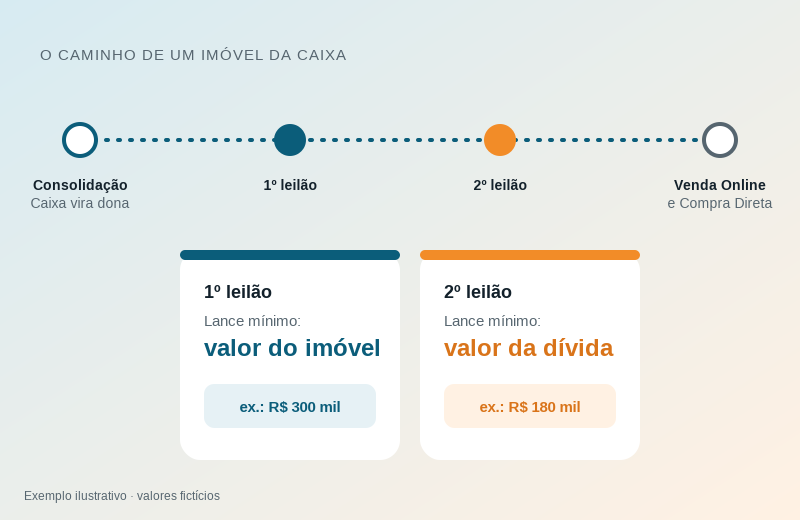
1. The path of the home
When a borrower stops paying, Caixa registers the consolidation of ownership and becomes the owner. The law then requires a public auction. In the listing it shows as "Leilão SFI - Edital Único", with two dates.
2. The 1st auction
The minimum bid is the property value set in the contract, or the value the city uses for the transfer tax (ITBI), whichever is higher. It is usually close to market price and often ends with no buyer.
3. The 2nd auction
It happens a few days later. Now the minimum is the debt plus expenses, taxes and overdue condo fees. If nobody bids that, Caixa may accept a bid of at least half of the appraised value.
4. What if nobody buys?
The home moves on to other Caixa options: Licitação Aberta, Venda Online and Compra Direta, with new prices and rules; some homes then accept loans or FGTS.
5. Costs people forget
- Auctioneer fee: usually 5% of the bid in auctions and open tenders.
- ITBI and registration: city tax and registry fees.
- Condo and IPTU debts: the notice (edital) says who pays.
- Eviction: if occupied, it is the buyer's responsibility.
For each home, Análise de Leilão CX shows the 2nd auction date, the minimum bid and how much cheaper it gets.
Informational article translated from Portuguese, summarizing Law 9.514/1997 as amended by Law 14.711/2023. Each home follows its own notice.